
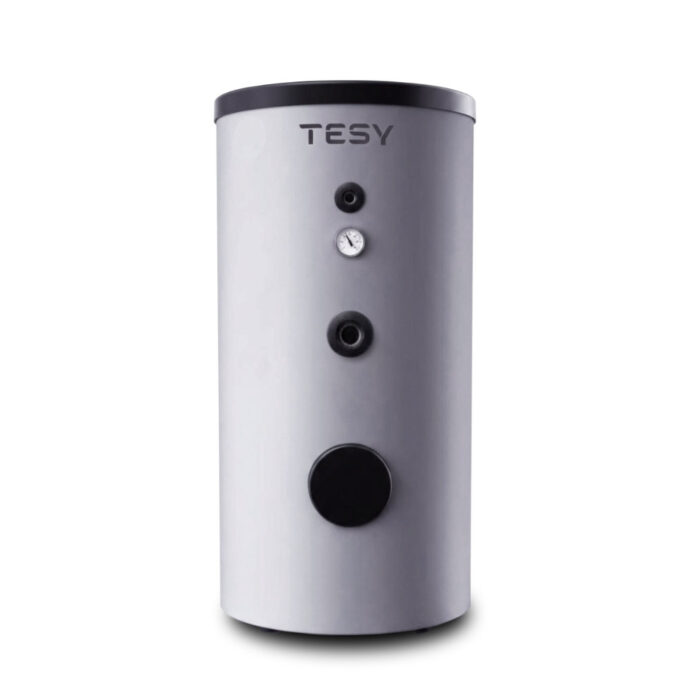
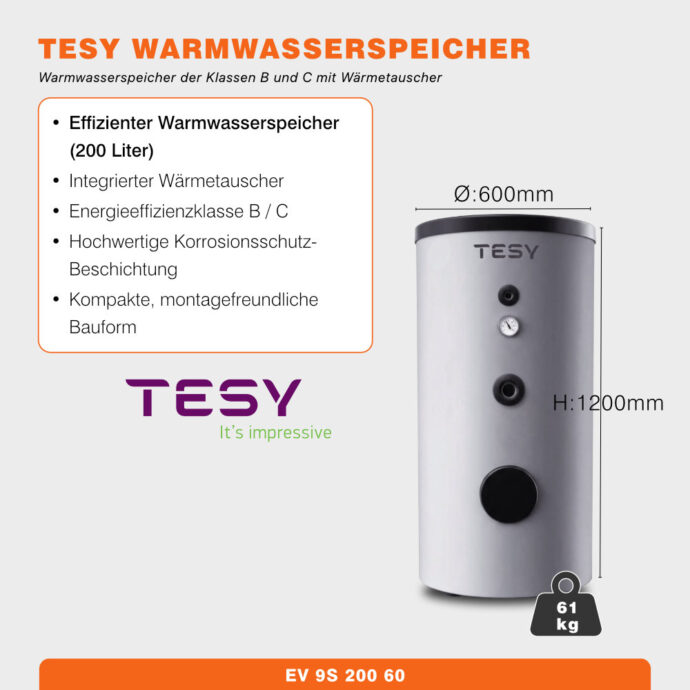
Highly efficient storage tank for solar and heating systems The TESY EV 9S 200 60 is a high-quality, enamelled buffer storage tank with a capacity of 200 liters and an integrated heat exchanger. This professional hot water storage tank is ideal for use in solar thermal, boiler, and heat pump systems and is perfectly suited for single-family and multi-family homes. Perfect for hot water heat pumps and domestic hot water heat pumps This high-quality hot water storage tank is specifically designed for use with modern domestic hot water heat pumps and heat pumps for domestic hot water. The integrated heat exchanger enables efficient heat transfer from your heat pump to the drinking water, ensuring maximum energy efficiency in daily operation. Key Features: durability and quality High-quality enameling for long service life Efficient anode protection against corrosion Robust construction with robotic welding technology Energy Efficiency Highly efficient PU insulation to minimize heat loss Energy efficiency class B or C according to EU Directive ErP 2010/30/EU Optimal heat storage for low operating costs flexibility and comfort Integrated heat exchanger for efficient heat transfer Option to install an electric heating element Option to install a thermostat Option to install a temperature sensor Maintenance flange for easy inspection of the device Applications: The TESY EV 9S 200 60 is versatile and can be used in: Hot water heat pumps of all types Domestic hot water heat pump systems Solar thermal systems Gas boiler systems Heat pump systems Combined heating systems Single-family homes and multi-family homes Technical information Model name TESY EV 9S 200 60 Nominal volume 200 liters (according to EN 12897) Diameter 600 mm Shape Vertical storage unit Number of heat exchangers 1 Inner container enamelled Corrosion Protection anode protection insulation Rigid PU foam (polyurethane) Energy Efficiency Class B or C (according to ErP 2010/30/EU) Maintenance Maintenance flange optional equipment Electric heating element, thermostat, temperature sensor Suitable for Solar, boiler, and heat pump systems Welding technology Robot welding Downloads Data sheet – TESY 200L hot water storage tank Operating instructions – TESY 200L hot water storage tank Declaration of Conformity – TESY 200L Hot Water Storage Tank Frequently asked questions (FAQs) How many people can a 200-liter hot water storage tank serve? A 200-liter hot water storage tank is sufficient for a four-person household. You can expect to use approximately 40-50 liters of hot water per person per day for showering, bathing, and personal hygiene. With 200 liters, you have ample reserves, even if several people shower consecutively. How long does it take for the storage tank to heat up? The heating time depends on the heating output and the starting temperature. With a typical output of 2-3 kW, the storage tank needs about 2-3 hours to heat 200 liters of water from 15°C to 60°C. Modern models with higher output can heat up faster. Does a hot water storage tank require regular maintenance? Yes, maintenance every 1-2 years is recommended. This should include checking the magnesium anode (corrosion protection), safety valves, and insulation. Flushing the storage tank every 5 years removes deposits and maintains efficiency. With proper maintenance, the lifespan is 10-15 years. Can I operate the hot water storage tank with photovoltaics? Yes, electric water heaters can be perfectly combined with photovoltaics. You can use the solar power you generate yourself to heat the water and thus significantly reduce your electricity costs. Ideally, you should heat the water heater during the day when the PV system is producing the most electricity. How much electricity does a 200L hot water storage tank consume? The annual electricity consumption for a four-person household for hot water preparation is approximately 2.400–3.200 kWh. At an electricity price of 30 cents/kWh, this equates to roughly 720–960 euros per year. These costs can be significantly reduced by using self-generated solar power.
Related products
$ 41.64
$ 55.52

Full Sleeve T-shirt
$ 62.68